
Master in Digital Architecture and Emergent Futures
25-29 May 2026
School of Architecture at Lund University invites you to presentation for degree project in Digital Architecture and Emergent Futures (ASEM01) on the 25-29 May 2026.
The presentations are public and take place in Black Box, A-building, Klas Anshelms väg 16, 223 62 Lund.

Agnieszka Paluch / Reversible Architecture for Coastal Landscapes
The aim of the thesis is to explore the relationship between people and the coast by designing a series of huts that serve as a meeting point. The project investigates the Danish coast as a constantly changing zone shaped by water, wind, ecological processes, and time. Instead of focusing on controlling the coast, the thesis focuses on how architecture can coexist with these dynamics while creating a closer relationship between humans and nature.
The project establishes a human–nature connection using local materials such as seaweed (eelgrass) and oak wood. The function of the project — smoking, selling, and eating local fish — also strengthens the experience of coastal landscape. Located in a nature reserve, the project uses principles of designing for disassembly to make minimal impact on the environment. The architecture is lightweight, elevated, reversible, and able to adapt, be dismantled, relocated, and reused over time.
The result is a small-scale architectural proposal consisting of three huts connected by an elevated deck, located in Kongelunden, in the Amager Nature Reserve near Copenhagen.

Kalina Slominska / GROWTH.
How can growth of plants become the core of an architectural project process through the use of digital tools?
GROWTH. re-defines the idea of growing in architecture, not as a constant increase, but rather growth performed in cycles of growth, stabilisation and decay which can be observed in nature. The re-defining is performed through exploration of the connection of regenerative agriculture and architecture through consideration of growth phases of biotic materials as a starting point of an architectural project. Digital tools are the enabler of this process.
The global approach to resources has only been in motion for the last 50 years (Steffen et al., 2004, p. 131). It is rather a short period considering the entire history of humans and the Earth. Currently due to rising concerns of the state of the planet and tightening regulations of embodied carbon, a local approach comes back into the picture. The thesis explores what ´local´ and ´regenerative´ means in connection to the opinions gathered from the architecture industry, literature, current projects and past techniques of vernacular architecture.
To create space for new ideas to be explored, sometimes it is necessary to look beyond the pragmatic realities of the current industry. This applies to GROWTH. when it comes to the aspect of time. Most current projects are focused on fast design and construction. This thesis omits this aspect of an architecture project in order to think freely and rather idealistically about alternative design processes where time does not play a role. Or rather, it plays a huge role but without the need to constantly ´make things faster`, but instead let architecture unfold in a process focused on resource availability and planetary boundaries.
The three main areas of focus are: simulation of growth rates of planted species, developing a physical prototype of a building system based on those simulations, and applying the GROWTH. strategy re-development of an ecological farm in Skåne.

Razisan Sasikaran / AI-Augmented Architectural Practice
Industry perspectives on AI integration in practice - examining current strategies for human-AI collaboration in design workflows.
This practice-based research investigates how generative AI (GenAI) systems reshape contemporary architectural practice, focusing on the tension between computational efficiency and the phenomenological values that have long defined architectural thinking. The study examines workflow transformations, governance dynamics, and the impact of AI integration on core design principles such as aesthetics, materiality, spatial quality, and embodied experience.
It situates current pattern-matching AI logics against earlier computational paradigms, including Soddu's interpretive generative design, to frame a critical inquiry into how authority, authorship, and architectural intelligence are redistributed when AI agents enter the design process. The research is organized around three guiding aims: mapping changes in design workflows, including time allocation and iteration depth; analyzing shifts in governance, particularly human oversight and the resolution of conflicts between AI agents; and evaluating architectural quality through systematic comparison of AI-augmented and traditional design outputs. A convergent parallel mixed-methods design is employed, combining quantitative usage logs (time allocation, override rates, iteration counts), ethnographic participant-observation, a reflective practice journal, and comparative design artifact analysis using a bipolar quality assessment scale across five dimensions. Three custom AI systems—a multi-agent Project Brief Pipeline, a Claude-Rhino Massing Buddy, and a Real-Time Design Iteration tool—are deployed across three case studies within the researcher-practitioner's solo practice.

Anna Bober / Material-driven 3D printing fabrication
Testing Biopolymerenhanced Clay mixes for Complex Architectural Geometry
The project investigates biopolymer-modified clay mixtures possibilities of robotic 3D printing in architecture through a material-driven design approach. The research combines material experimentation with computational fabrication and design proposal of a large-scale robot 3D printed architectural forms with 1:1 printed prototype pieces. The study is divided into two parts: theoretical material and technical research into clay-based mixes, and hands-on prototyping through 3D printing tests.
The theoretical material and technical research examines the development of 3D printing in architecture, focusing on clay and earthen materials as sustainable alternatives to concrete-based additive manufacturing with primal attention to the uniqueness and creative freedom that 3D printing allows. The integration includes biopolymers and additives such as sodium alginate, xanthan gum, carboxymethyl cellulose (CMC), with addition of sand and sawdust, investigating their influence on printability, structural behaviour, and geometric possibilities.
The prototyping phase consists of material testing and shape experimentation with the most promising mix that was possible to test on a clay 3D printer. The test compares pure clay and clay with sodium alginate in regards to its flow and extrusion, overhang possibilities, layer adhesion, and detail printability. Findings demonstrate that pure clay performs better for fine-detail geometries, while clay mixed with sodium alginate gives promising results for larger nozzles, fluid forms, and overhanging geometries. Rather than identifying a universally optimal mixture, the research reveals that distinct behaviours of material mixes are suitable for different fabrication strategies and architectural expressions.
The final outcome is a robotic 3D printed segment of a column and a brick prototype developed using the most suitable material mix according to the geometry. The thesis proposes that material behaviour should actively inform computational design and robotic fabrication processes in architectural additive manufacturing.

Bhavya Rishi / The Breathing Skeleton - Algorithmic Service Routing as a Tectonic Generator
Every modern building has a hidden circulatory and respiratory system, yet architects routinely treat Heating, Ventilation, and Air Conditioning (HVAC) as an uncoordinated, late-stage afterthought. This project tries to invert that traditional paradigm, proposing a design methodology where complex, volumetric routing of ventilation ductwork ceases to be hidden. They instead emerge as the primary generator of both spatial qualities and structural form.
Using a custom framework, the design process is applied to a real-world case study, the renovation of Academic Block 3 at Indian Institute of Technology (IIT) Delhi, which is a landmark modernist concrete structure designed by Architect J.K. Chowdhary in the 1960s. By retrofitting this historic grid, this project tries to demonstrate how algorithmic service routing can adapt to and transform existing architecture.
The design strategy mutates across three distinct floor strategies. The ground floor prioritizes hidden efficiency, snapping duct paths strictly to the concrete grid to dodge deep beams. The first floor showcases non orthogonal path finding, utilizing Voronoi Relaxation to distribute air diffusers with biological efficiency, leaving a radically shaped ductwork fully exposed as a dominant spatial element.
Finally, on the new, lightweight top floor, the building’s skeleton and metabolism merge completely. A volumetric 3D pathfinding network is generated first, direct dictating the subsequent form of triangulated space frames anchored solely to the preexisting columns. They are connected by custom 3D printed hollow joints that act simultaneously as load bearing hubs and air distribution diverters.
This project hopes to showcase a future where building services no longer clash with design but rather breathe life into the architecture.

Lucia Retseletsi Modipi / From Shack to System
Decoding Informal Housing Logic into Computational Frameworks for Circular Adaptive Communal Housing
What would it mean for a building never to be finished?
When looking at informal settlements, specifically the umkhukhu in South African townships, buildings there grow bit by bit, use whatever materials are available, and are continuously taken apart and rebuilt. There is no set completion date for informal housing systems.
And the basis of this thesis is influenced by that logic, a way of not looking at buildings in a static state, not only at what could be adapted, but rather at what housing systems could be.
In most developed urban environments, we find formal housing systems that are more functional, rigid, and planned. They are built according to regulations, and once the project reaches completion, little to no adaptation is often introduced unless needed. In this context, this thesis focuses on a formal housing system in Rosengård, a long Million Programme block in Malmö, which is a good precedent as a solid, repetitive, durable, but permanent structure. This thesis uses it as a test case to determine whether the same adaptive logic found in township housing can work here, within a regulated Swedish context.
This thesis explores whether the introduction of a lightweight modular framework attached to the existing facade can introduce an open system into struggling formal housing systems, introducing user-based possibilities rather than prescription.
The point is not to romanticise informality or import its aesthetics. But rather question whether formal housing can be open to change, not through demolition or large renovation, but through small adaptations that accumulate.

Tomáš Bajer / Synthesising spatial reasoning for furniture layout generation
Can a hybrid optimization system combining explicit, rule-driven agent simulation with LLM-based spatial reasoning produce room layouts that satisfy both measurable ergonomic criteria and higher-order architectural qualities?
Traditional computational approaches excel at optimizing quantifiable constraints like clearance, daylight access, and path blocking, but remain blind to abstract spatial concepts like zoning, flow of space, and visual composition. Conversely, Large Language Models (LLMs) excel at semantic reasoning and describing spatial experiences, yet inherently struggle with precise dimensions, proportions, and scale. To resolve this tension, this framework is designed around the complementary capabilities of both paradigms.
The proposed system encodes an architect's empirical experience of ergonomics and object usability into a synthesized set of explicit rules. Spaces and objects are simplified and rasterized onto a grid, distilling their spatial syntax into functional cells and deterministic fitness functions. To evaluate the layout globally, the system moves beyond individual object placement to analyse circulation, visual perception, and navigation. This is achieved through pathfinding, iso-vist fields for dead- corner detection, daylight simulation, and inscribed circles rooted in principles of convex space division.
Different approaches for synthesising layouts and their aspects are explored. At the object level, functional clusters (such as kitchen working triangles or living room seating) are generated via rule-constrained procedural aggregation. At the room level, a simulated annealing optimization loop maximizes deterministic, rule-based fitness. Simulating the role of an architect, the LLM leverages semantic and syntactical context to reason about and optimize space - feeding strategic intent back into the geometric simulation loop.

Milena Gloinec / The In-Between - A modular second insulation skin bringing old and new
As sustainability goals gain importance, both the renovation of existing buildings and the transformation of construction methods are becoming priorities that may drive innovation in current practices.
Within this context, this research examines through a design-based methodology the relationship between computational design, craftsmanship, and material innovation. Through a series of material and computational experimentations, the project investigates the architectural potential of blue biomass, particularly eelgrass, as a contemporary construction resource.
Historically used as a roofing material in vernacular Danish architecture, eelgrass is reconsidered as a renewable material capable of supporting low-carbon design approaches for facade cladding. Locally sourced, eelgrass used in its raw and minimally processed form, can form the basis for new facade insulation systems and architectural assemblies inspired by coastal craft traditions. Viewed through this lens, eelgrass becomes more than a building material, it emerges as a spatial language for resilience, enabling dynamic, responsive, and context-sensitive architectural strategies in the face of environmental change. It preserves a cultural heritage and aims first to extend the lifespan of buildings and respond to evolving ecological and societal challenges. Particular attention is given to the transformation of an industrial building in the area of Copenhagen and technical challenges associated with adapting existing structures to new uses.
All in all, this thesis aims at contributing to the advancement of sustainable architecture by addressing the transmission of traditional knowledge and showcasing innovative methodologies for rethinking building practices, weaving together heritage and technology.

Maria Tani / Neighbourhood for Better Health – An Exploration of Architecture and Everyday Movement
This project explores how residential architecture can encourage everyday movement through the design of homes, shared spaces, and neighbourhood environments. The project reflects on increasingly sedentary lifestyles, where everyday environments are often shaped around comfort, efficiency, and minimizing physical effort. As modern life offers more opportunities to avoid movement in daily routines, I became interested in how architecture could instead integrate activity more naturally into everyday life.
Rather than relying on explicit fitness-oriented solutions, the proposal examines how spatial organisation, circulation, landscape strategies, and shared facilities can subtly encourage movement and social interaction. Focusing on a small residential neighbourhood in Sweden, the project explores how the design of housing and communal environments can shape patterns of activity, behaviour, and engagement with the surrounding environment.
Instead of prescribing behaviour, the project views architecture as a framework that can support more active and socially connected ways of living by integrating movement and interaction into everyday routines.

Zhifeng Cai / Space Growing: A Multi-Step Neural Framework for 3D Architectural Completion using RAG and Voxel Transformers
Architecture exists at the intersection of art and engineering, materially defined by the spaces enclosed within physical boundaries. Just as natural language processing allows machines to parse written text, artificial intelligence can comprehend architectural space when it is translated into a structured, objective format. This thesis proposes a novel machine learning framework for the automated understanding and generation of 3D architectural environments.
By utilizing voxel grids as a fundamental spatial syntax, we introduce a bespoke Retrieval-Augmented Generation (RAG) system driven by a Transformer architecture. The model generates structures iteratively through two distinct stages: a "Bridge" phase, which logically connects existing architectural contexts to retrieved pattern seeds, and a "Grow" phase, which expands the building envelope based on spatial constraints. Evaluated against rigorous geometric and topological metrics—including bounding box leakage, void ratio, and spatial continuity—the results demonstrate the system's capability to successfully learn architectural rules and autonomously roll-out structurally coherent building spaces.

Amasha Bodiya Baduge / Bio-inspired framework for the Adaptive Reuse of Brick Rubble in Architecture
This project explores an architectural methodology to upcycles irregular, reclaimed brick rubble into high-performance structural elements, moving beyond conventional low-grade downcycling. By translating the biological, selective sorting behaviors of case-building caddisfly larvae into a digital design framework, the research investigates how material heterogeneity can be harnessed rather than suppressed. This biomimetic organizational logic is physically manifested through the design and analysis of an 8-meter-tall, hollow diagrid column. The structural columns feature complex, intersecting masonry struts that shift from computationally engineered uniformity to irregular, handcrafted intersection zones. Ultimately, the column serves as a primary case study demonstrating how a hybrid workflow, uniting algorithmic precision with artisanal craftsmanship, can successfully transform unpredictable, non-standard waste materials into a sophisticated, load-bearing architectural form.

Filipe Guedes / Acoustic Structures _ Material Research through Sonic Fingerprints and Data Visualization
Architectural classification has long been constrained to visual standards, defining materials as flat surfaces or static geometric volumes. Yet, when dealing with reused materials, frequently non-standard and irregular, this surface-level consideration is not enough. To surpass this visual bias, this thesis introduces a research workflow that interrogates the hidden identity of physical materials through their acoustic parameters.
By subjecting a heterogeneous set of waste and reused architectural materials to systematic acoustic tests, the research treats internal resonance as a primary source of material reality. This sonic approach allows the material to detach from its superficial visual state, transforming physical matter into raw waves, frequencies, and numbers. From this translation, unexpected hidden physical relationships, similarities, and oppositions start to reveal. This diagnostic process traces back to the stochastic logic of Iannis Xenakis and the sonic landscapes of Bernhard Leitner. Listening to the physical pieces transforms material analysis from an inspection into a dialogue with the material's inner structure.
The project culminates in a series of custom interactive interfaces that demonstrate the vital role of aesthetics in scientific research. Rather than serving as passive illustrations of data, these act as filters to isolate meaningful material properties. Working also with a Self-Organizing Map to find relational patterns in the sonic fingerprints, these curated infographics translate acoustic signals into a legible geometric and topological language. Ultimately, this thesis bridges the gap between raw engineering and architectural design. By curating a multisensory framework to navigate and extract properties from our physical environment, the project expands architecture's traditional field of action, reframing the contemporary architect as also a material diagnostician.

Sandy Meneses Polo / Reactivating Industrial Heritage: Adaptive Reuse of Kvarnhus Brottet, the Limhamn Limestone Millhouse
Kalkbrottet, located in the growing district of Limhamn, is a singular topographic void in Malmö shaped by a century of limestone extraction. Over time, vegetation and wildlife have reclaimed the area, creating a beautiful example of natural regeneration. Today, the former quarry has become a nature reserve, representing a unique transition between industrial heritage and ecological recovery.
There is a physical and symbolic separation between the expanding city and the reserve, where traces of the site’s industrial past remain visible, including the abandoned limestone millhouse located at the edge of the site. The building remains a relic of a period when the surrounding landscape was defined by extraction and production.
The existing structure presents an opportunity to explore adaptive reuse architecture and its potential to reconnect the local community with the reserve. This project proposes the transformation of the deteriorated industrial complex into a hybrid public center that supports community life through culture, sports, and education.
Computational design is used as a tool to understand the existing structure and develop strategies for its reactivation and connection with the regenerating natural landscape. The study explores how parametric analysis can support regenerative design strategies, including structural assessment, selective subtraction, optimization of material reuse, and the integration of new reinforcing elements that stabilize the deteriorated structure. The objective is to preserve its material identity and architectural character and adapt it to new forms of public use and interaction with the site’s new identity.

Simon Smedegaard / Parametric Masonry Partitions
This thesis investigates how interior masonry partitions can be reconsidered as reconfigurable material systems for adaptive interiors. The project begins from the tension between the long lifespan of building materials and the shorter cycles through which interior spaces change.
The thesis develops and tests a rule-based masonry partition system in which brick placement, spacing, bond, binding, assembly, and reassembly are coordinated as parts of one architectural logic. Instead of beginning with a finished building proposal or a single final wall object, the project works through a controlled material rule set and studies how architectural variation can emerge through geometric generation, physical testing, material behaviour, and transformation over time.
The system is developed through digital tests, scale models, full-scale brick experiments, binding tests, assembly studies, reassembly sequence testing, and architectural scenario lenses. These studies examine how masonry can follow variable wall geometries, maintain coherent bond conditions, introduce controlled porosity, connect to external elements, and support later release and reassembly.
The central question is whether masonry can retain its material weight, spatial presence, and architectural character while becoming more available for future transformation. Instead of treating a brick partition as a fixed object that must be demolished when spatial needs change, the thesis explores the wall as a material state within a longer architectural sequence.
The project does not propose a finished construction product, certified structural system, or complete robotic fabrication workflow. Its contribution is a tested architectural framework for understanding masonry partitions as controlled, reconfigurable interior systems. By linking parametric placement, material behaviour, reversible binding, assembly sequence, and reassembly logic, the thesis suggests that masonry can operate not only as a completed boundary, but as an adaptable spatial infrastructure for interiors that change over time.

Elvira Hjortstam / Assembled Again
Material Memory and Computationally Crafted Patterns of re-used bricks in Contemporary Half-Timber Architecture
This thesis investigates how computational design methods can translate individually distinct reused brick fragments into expressive architectural façade systems. By combining material classification, digital pattern generation, and principles of robotic fabrication, the project explores how variation can be composed rather than eliminated.
The research is situated within the historical context of half-timbered architecture in Skåne and eastern Denmark, resulting in the architectural application of a contemporary half-timber villa in Hæsnæs, Denmark. Here, infill masonry becomes a medium for negotiating between material memory, industrialised waste streams, and digital design systems. Rather than seeking uniformity, the thesis proposes a framework where irregularity, reuse, and computational logic collectively create architectural expression. The outcome suggests a hybrid condition in which human handmade artistic expression and digital processes collaborate to produce material-driven, non-standard architectural surfaces rooted in locality and reuse.
“Uniqueness is not corrected or accidental, but composed.”

Angela Darina Menchise / Augmented Studio: Developing a Hybrid Method of Work Through Tangible Interfaces and Web-AR
The use of Extended Reality (XR) technologies within the Architecture, Engineering, and Construction (AEC) industry has grown significantly in recent years. While Virtual and Augmented Reality (VR/AR) are increasingly integrated into professional workflows for visualisation, simulation, and coordination, their potential within participatory and early-stage design processes remains comparatively underexplored. This thesis investigates how Web-based Augmented Reality (Web-AR), combined with Tangible User Interfaces (TUIs), can support communication and shared spatial understanding between professional architects and non-professional stakeholders.
Adopting a Research through Design (RtD) methodology, the study develops the “Augmented Studio”: a hybrid representational and interaction system that combines physical tokens, graphic markers, and digital overlays within accessible AR environments. Operating through camera-enabled devices and browser-based technologies, the system explores alternative methods of work that reduce technological barriers while maintaining embodied and collaborative forms of interaction. Through iterative prototyping, the research investigates the relationships between physical manipulation, spatial representation, and augmented feedback, progressively developing modular interaction behaviours capable of supporting participatory exploration and communication.
The development process involved continuous experimentation with tracking systems, material fabrication, marker integration, and relational interaction workflows. Informal exploratory interactions conducted with non-professional participants highlighted both the accessibility and communicative potential of the hybrid interface, while also informing subsequent refinements of the system. The findings suggest that hybrid AR environments based on tangible interaction and low-friction deployment can support more intuitive and inclusive forms of spatial communication within participatory design contexts.
The thesis concludes that Web-AR and tangible hybrid interfaces hold significant potential as accessible collaborative tools within architectural practice and education. By repositioning XR technologies as communicative and interactive media rather than solely representational tools, the research proposes an alternative framework for the future development of participatory and technologically mediated design environments.

Alice Welin/ The Digital Living Room
Architecture is often understood as what is yet to be built. This thesis shifts attention toward what is already lived. The Digital Living Room investigates the lived domestic interior as a site of architectural knowledge. Through interviews, photography, and LiDAR scanning, four living rooms in Southern Sweden are documented as they were found: occupied, accumulated, and shaped by the habits and histories of the people who live there.
The thesis argues that architecture exists foremost in the spaces people occupy daily, shape through use, and carry with them through memory. The collected material is investigated through two parallel approaches. The first presents the four rooms through photographs and narrative descriptions, treating each interior as a portrait of its inhabitant. The second processes the scanned data through a series of digital studies, moving from conventional architectural drawing to point cloud accumulation, conceptual manipulation, and topoanalysis. Topoanalysis, a concept from Bachelard's phenomenology of domestic space, treats specific spatial environments as sites where memory, imagination, and identity converge. The digital manipulations are interpretative acts, each motivated by something specific observed in a room or heard in conversation. They ask what becomes visible when a lived interior is translated into digital form, and where that translation falls short. The thesis concludes that digital technologies can capture and represent the emotional and personal dimensions of domestic space, though always partially. The gaps and distortions of the scan are understood as honest: they mark the boundary between what can be documented and what can only be carried in memory.

Anup Chhetri / Exploring Architecture in Morphology through Machine Learning
The application of machine learning in architecture has raised important concerns regarding creativity, authorship and the usability of AI-generated outputs. An existing limitation is that many generative workflows produce visually compelling images but they remain as visual residue. They may demonstrate rich architectural qualities, but they are detached from the design workflow. This thesis explores how machine learning can be used as a form-finding medium to translate abstract morphological patterns into architectural form and editable three-dimensional design artefacts, while retaining the designer’s authorship throughout the process.
The research begins by taking inference from architecture design process, which often starts with an abstract sketch and gradually evolves into conceptual form.
This thesis follows a research-through-design methodology structured across three sequential phases: Creation, Transformation, and Generation. In Creation phase, synthetic morphological patterns are generated and hybridized to mimic the unpredictable and complex morphologies of nature. In Transformation Phase, the hybrid morphological patterns are translated to architectural forms using a machine learning model for image-to-image translation. Instead, of training the model to directly imitate the existing buildings, the transformation is learned through a custom dataset curated around architectural formal qualities. In Generation phase, selected two-dimensional outputs are generated as three-dimensional model by integrating 3D reconstruction model directly inside architecture design tools.
This research demonstrates that the abstract morphological patterns with no direct architectural origin can be successfully translated into architectural forms and finally to editable three-dimensional geometry. The generated forms carry architectural qualities such as surface articulation, tectonic character and spatial depth while still preserving the original morphological identity. However, the outputs remain conceptual form-finding artefacts rather than complete architectural proposals.
This thesis proposes a grey-box workflow: a structured planning of existing machine learning tools in design process which places the designer as curator, evaluator and decision maker at every stage. The thesis positions machine learning not as an autonomous system, but as an expert collaborator for exploring architectural formal possibilities.

Jose Moreira / Mimicry of Natural Morphology

Telma Tereze Ledina / Systemic Adaptation of Soviet Mass Housing
A Computational Framework for Spatial and Structural Reorganization
This thesis aims to address a dual crisis. Globally, the construction industry relies on a linear “take-make-dispose” approach and a “tabula rasa” tactic in each novel project, draining the Earth’s resources. Locally, around a half of residential buildings in Riga, Latvia, are of Soviet mass housing typology. These structures are on the verge of structural expiration, at risk of progressive collapse, and are spatially obsolete.
Because conventional architectural methods, such as façade thermal insulation and renovation projects, fail to address the core spatial and structural issues due to the inherent structural complexity and rigidity of prefabricated concrete panel structures, a new approach must be designed.
Using the prevalent Soviet series 1-464A as an object building, this research proposes a computational methodology for adaptive transformation, “self-cannibalization”, and circular material reuse. Leveraging the building’s modularity, a high-reliability digital twin of each element, as well as the overall assembly, was created. Next, the structural scheme was evaluated to form a structural dependency matrix. From this, a custom dependency script was developed to enable precise structural reliance detection.
Guided by a visual input tool – a grayscale image sampler – the user proposes spatial alterations of the building. The algorithm then uses the established dependencies, as well as the user input, to determine forced alteration versus “free to alter” ones. Additionally, this system accounts for all material and elements removed to enable immediate circular reapplication in the architectural synthesis stage.
Tested through a series of experiments, this tool successfully bridges user-guided design with computational logic. The final architectural synthesis output proves that the system successfully enables spatial reorganization while retaining the structural integrity of the building. Ultimately, this methodology challenges the construction industry’s reliance on raw material consumption, simultaneously extending the life span of “expired” buildings.

Xiaotong Zhang / Spatial Order in Villages - Translating Traditional Village Spatial Logic into Contemporary
In recent years, China has carried out large-scale poverty alleviation and relocation policies, helping many people living in remote mountain areas move into newly built urban resettlement communities near cities. These policies greatly improved living conditions, but at the same time, many daily rhythms and living habits that once existed in villages have been strongly affected by standardized urban resettlement communities.
Based on this background, this research aims to rethink the spatial logic of traditional villages. It focuses on the spatial relationships that naturally formed in villages, studies how these spaces influence people’s daily lives, and explores whether these spatial logics can be translated into contemporary Chinese urban resettlement communities.
The research studies ten traditional villages in southeastern China through fieldwork, photography, 3D scanning, and hand drawings. At the same time, the research combines drawing and spatial analysis to understand village spatial order through points, lines, and planes. “Points” represent road intersections, turning points, and nodes where spatial changes happen. “Lines” represent path systems and spatial connections. “Planes” represent open spaces, courtyards, and voids naturally formed between buildings. The research further analyzes node connectivity, node proximity, path curvature intensity, and spatial morphology, and summarizes the hidden spatial patterns inside villages.
The theoretical foundation of this research is influenced by Heidegger, Merleau-Ponty, and Pallasmaa’s theories about bodily perception and dwelling. It is also inspired by the research methods of Hillier & Hanson and Rudofsky on spatial relationships, informal order, and vernacular architecture.
Finally, this research attempts to transform these spatial findings from villages into a series of design guidelines and apply them to contemporary Chinese urban resettlement community design. The goal is to explore a spatial generation method that can better recreate village ways of living and everyday spatial relationships.

Ali Baadpei / Morphing Mosaics: From Persian Tiling to Living Skins
One question has stayed with me throughout this work, whether it is truly possible to bring a thousand-year-old legacy back to life. Not as a decorative image on a wall, but as something that actually functions, breathes, and holds a real conversation with its surroundings. This thesis is my attempt to find out.
The starting point was the geometry that Iranian architects carved onto tile surfaces centuries
ago, with no software, no parametric tools; nothing but intuition and accumulated experience.
Those same patterns that, even today, stir something in you when you stand before the tomb of
Omar Khayyam. But rather than copying them, this research pulls from their hidden logic ( from
that underlying mathematical grid) to build something entirely new: a kinetic folding skin, rooted
in the principles of origami.
This skin is designed as an independent layer that can attach to the body of almost any existing
building. Not a decorative feature, not a separate structure; but an exterior cladding that
connects mechanically to the main skeleton of a building and, from the moment it is installed,
begins to earn its place. That value shows up on several levels: a significant reduction in
thermal load under the harsh dry climate, intelligent daylight control without any need for
complex electronics, and the elimination of direct solar penetration; one of the most stubborn
sources of energy loss in conventional buildings.
But perhaps the most unexpected part is this: the skin can sense when someone is near. As it
detects human presence in the adjacent space, the way its panels open and close shifts; not
only in response to the sun's angle, but to the immediate need for privacy. What that means, in
practical terms, is a building that actually responds to the life happening inside it.
In terms of process, everything began with folding paper. Physical hand-made prototypes were
what revealed the mechanical limits of the system, and that same logic was later brought into
Grasshopper and developed into a precise computational model using the Crane plugin. What
this research ultimately proposes is not just a technical system; it is a reconsideration of the
relationship between cultural identity and architectural performance. A quiet argument that
ornament can, at the same time, be beautiful, intelligent, and genuinely useful.
Archive of Previous Degree Projects
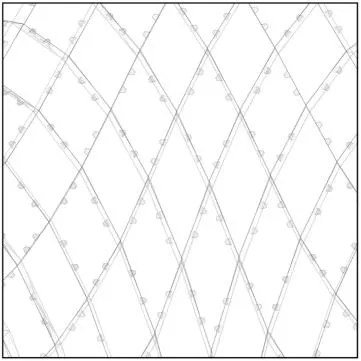
Cesar Andres Velando Garcia
Due to the climate crisis we are facing, we can no longer consider current construction methods, which contribute to 40% of global CO₂ emissions, as an alternative to building. Vernacular architecture, in comparison, offers a sustainable alternative.
People have tested this way of designing, constructing, and living throughout time. This system essentially stands for maximizing efficiency by achieving more with fewer resources. This thesis explores how technology can rediscover vernacular principles to address unsustainable construction practices.
The contents include a review of modern methods, what makes them unsustainable, and a comparison to traditional techniques like the Nubian vault, the Musgum huts, and the Catalan vault. Emphasizing the way these methods use simple materials to achieve sustainable living spaces. Furthermore, case studies, such as the Armadillo Vault, EcoCocon, and the lunar habitat projects, demonstrate how to digitize vernacular principles through computational workflows to optimize them for modern use.
In response to the ongoing resurgence of urban farms, the proposal reintroduces the root cellar back into our dwellings. Fundamental to the structure of the cellar is a parametric Catalan vault, which was created using Rhino and Grasshopper. The system digitizes structural optimization and facilitates fabrication while compiling centuries of knowledge and skills into a workflow that can scale and adapt to any site. Features like the interlock system simplify the complex craft of Catalan vaulting, backfilling techniques remove the need for formwork, and sinusoidal-shaped columns add rigidity to the structure.
The digital vernacular solution makes sustainable construction more accessible, offering a low-carbon alternative. It defies the negative stigma by demonstrating that traditional methods can still work well today by incorporating technology. This thesis justifies that hybrid systems are crucial for reducing the environmental impact of buildings and advocates for an architecture that promotes collaboration between sustainability and technology.
Mars Planet Merah / Robotic Free-Form Timber
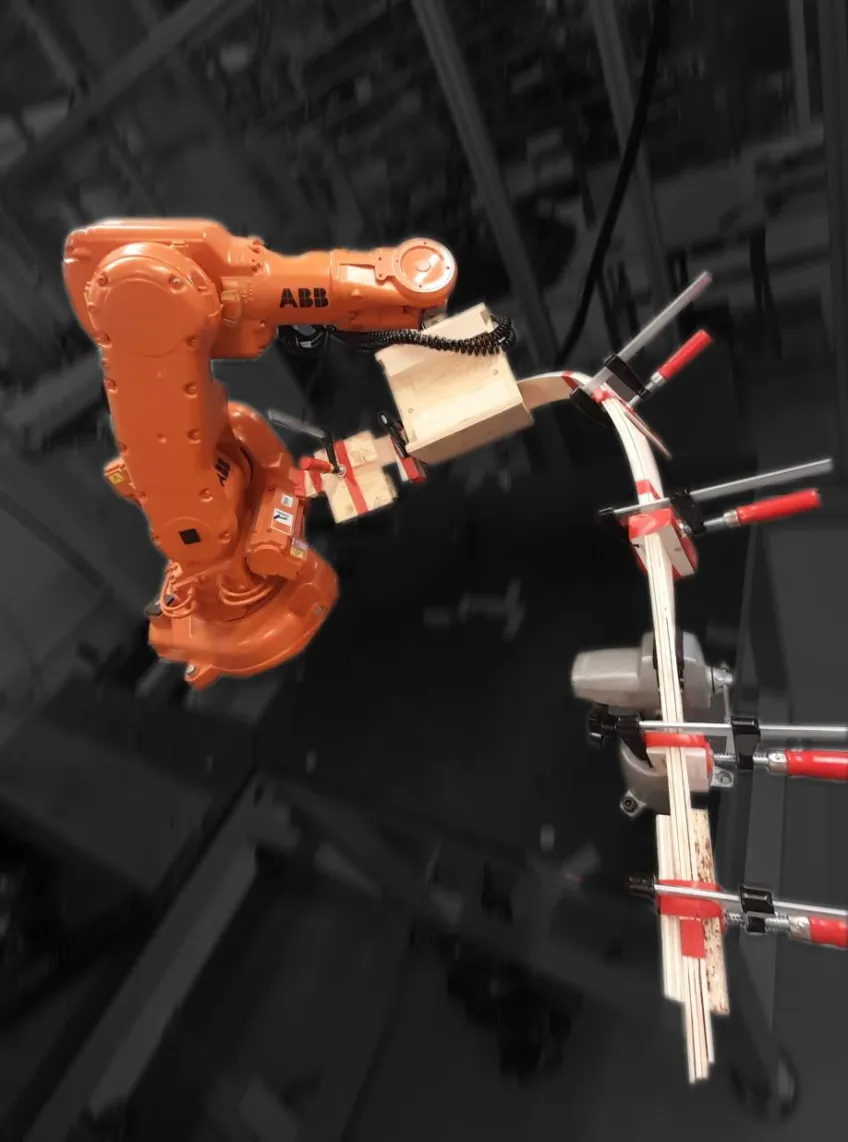
This project aims to explore and study of fabricating free-form timber structure using robot fabrication. Solid ash laminated timber is used as the material to ensure the manufacturing of load bearing structural components. The use of an industrial robot offers significant advantage due to its six degrees of freedom allowing any plane on the timber can rotate along x, y and z axes.
The project includes an experimental investigation into the timber bending behaviour of timber in relation to robot path planning. The experiment examines the interaction between several key factors, the robotic gripping tool for bending, the soaking and steaming process of the timber, the positioning of clamping tools and the robot path planning programming.
This experiment has yielded several key insights. First, the steam-bending process plays a crucial role in enabling the fabrication of large amount laminated timber layers by softening the lignin, thereby reducing tensional strain on the robot. Second, increasing the number of laminated layers helps the bent timber retain its shape more effectively. Third, it is essential to apply even clamping pressure approximately every 150 mm during the holding phase (before it is release from the robot). Fourth, architect can achieve the desire timber form by adjusting the robot’s path planning, either by moving along robot axes using MoveAbjsJ, or by targeting defined Move based on the defined points using MoveJ.
Following the bending experiments, the project investigates and develops a method for assembling free-form timber to create architectural space, such as with scandinavian style. Initial experiments involved 3D-printed joints and assembled in non-planar surfaces by the robot. However, it was eventually shifted into more simple and robust joint types, such as screws and traditional timber joinery. The assembling-design demonstrates that architects can achieve their desired free form timber shapes by adjusting robot path planning.
Sebastian Arturo Garcia Nuñez / Algorithmic Assembly procedure for Upcycled Concrete Rubble
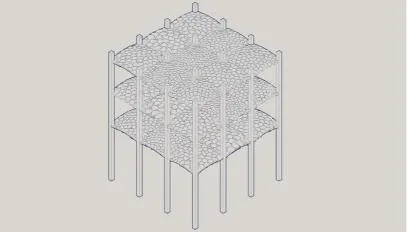
The thesis project explores a circular approach to architectural design by developing an algorithmic method for vaulted floor slabs using re-assembled upcycled concrete rubble.
The project aims to establish a reflection on the idea of the linear cradle-to-grave design -in which materials have a life ending- and propose a way to give them a new use and transform waste into resources (Lendager, Pedersen 2020). This project reimagines waste concrete as a valuable resource for new structures.
The design process begins with scanning irregular concrete rubble pieces using image processing libraries in Python (OpenCV) and converting 2D contours into scaled 3D geometries. A machine learning pipeline (PCA-based) is used to simulate additional rubble variations, expanding the digital stock of elements and embracing the ad-hoc condition of reclaimed concrete pieces.
Structural analysis and form finding methods are performed using Kiwi3D and Karamba, to simulate funicular vault shapes that efficiently transfer loads. These shapes guide a custom stacking algorithm built in Grasshopper, which uses OpenNest and iterative geometric optimization to minimize voids and maximize material use, achieving more than 90% packing efficiency.
A stability-checking algorithm further ensures that the assembled pieces align correctly within the stress lines, avoiding connections parallel to the structural efforts, reducing the risk of displacements and guaranteeing a correct stable assembly.
Finally, an LCA analysis is performed in a case study project, comparing the environmental impact of using upcycling construction methodologies versus the traditional construction method.
The system will demonstrate not only material and CO₂ reductions, but also adaptability and structural logic. This computational design workflow provides a scalable, replicable strategy for integrating reclaimed concrete into architectural practice, pointing towards a more circular and conscious design approach.
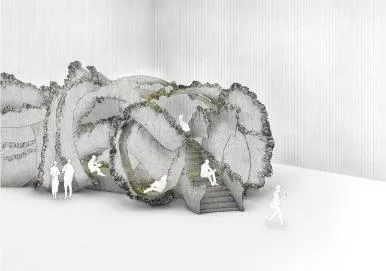
Zhuoxuan Chen / Self-Monitoring and Self-Healing Lunar Habitat
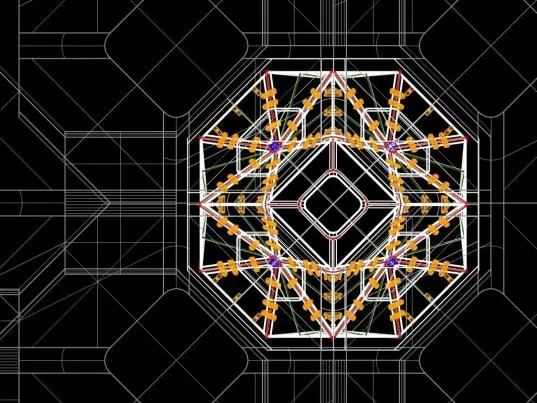
This project explores a novel approach to fabricating systematic protective shells for lunar habitats by synergizing mycelium-based biomaterials with robotic systems.
Farzaneh Aghamohammadhassani / Living fibers: Wool in Transformative Design
This project began with an interest in renewable materials, especially those with the potential to behave and change over time in response to their surroundings. Wool, as a natural fiber, offered this long-term responsiveness to environmental changes — making it a meaningful starting point for a design that aims to be alive.
Many contemporary architectural spaces include nature only in decorative or surface-level ways. They often lack a deeper connection — one that can be felt through the body and sensed emotionally. This work challenges that by proposing a design that encourages interaction and emotional response. It follows ideas from biophilic design, which focuses on strengthening the relationship between people and the natural world in built environments.
Inspired by patterns of natural growth, especially the principle of differential growth, the project explores how a form can develop from simple rules. Starting from digital simulations, the process moved into physical making through techniques like crocheting, needle felting; layering wool, allowing the form to grow slowly by hand, mimicking how things in nature grow, unevenly, organically, and over time.
Rather than aiming for a fixed final shape, this design embraces gradual transformation. It reacts to its surroundings, shifting in surface, tension, and density based on changes in air, moisture, and temperature.
Over time, the structure becomes a soft, calm presence within the space, not just as a visual object, but as something that interacts with the environment. The conditions it helps create may support the slow development of natural growth, deepening the connection between the built and the living. In this way, the piece becomes more than a design, it becomes a quiet host within its setting.

Shadi Daneshvar Kakhki / Using Generative AI to Explore Termite Inspired Architectural Forms
This research project explores how generative artificial intelligence can be used beyond image rendering, specifically investigating its potential as a tool for architectural form finding inspired by nature.
Inspired by the natural efficiency of termite mounds, known for their complex spatial organization and passive ventilation systems, this project aims to reconstruct similar forms through AI-driven processes.
The methodology combines computational scripting, dataset creation, AI model training, and three-dimensional reconstruction. A 3D model of a termite mound served as the foundation for dataset generation. Sectional slices were extracted from different orientations to produce a varied dataset. Three types of datasets were developed: open view sections (including full depth and shadow), capped surface sections (simplified flat slices), and hole-and-tunnel-focused sections emphasizing porosity. These datasets were paired with automated captioning strategies to examine how textual guidance influences generative AI training outcomes.
Multiple LoRA models were trained using Stable Diffusion XL 1.5 and HunyuanVideo, utilizing both image-based and video-based datasets. The training process tested different dataset types, captioning strategies, and workflow adjustments to produce AI-generated sectional walkthroughs. These walkthroughs were then reconstructed into 3D meshes using both conventional modeling tools and medical imaging software to generate printable volumes.
The results reveal how variations in dataset composition and training strategy affect the structural logic, continuity, and spatial qualities of the generated forms. Selected models were refined for physical fabrication through 3D printing, highlighting different formal features shaped by different experimental methods.
Ultimately, this research proposes a new workflow for integrating generative AI into architectural design, where biological inspiration and deep learning intersect. The outcomes demonstrate both the possibilities and current limitations of using AI not just as an aesthetic tool, but as a contributor to architectural reasoning and form development.
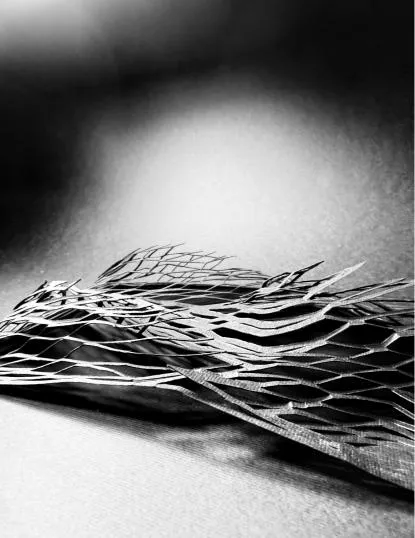
Karyna Kameiko / Kerf Structures for Flood-Responsive Architecture
This diploma project investigates the potential of applying transformation principles from the fashion industry to architecture—specifically, how simple textile techniques such as seams, cuts, and slits can transform a flat 2D surface into a 3D volume. This fashion-based logic serves as the foundation for an architectural concept grounded in kerf patterns or lattice-hinge structures - systems that combine rigid and flexible areas, allowing materials to bend, expand, and adapt to external conditions without losing structural integrity.
The proposed design is a modular system composed of pre-programmed deformation patterns, informed by the inflated geometry. By incorporating strategic cuts and hinge-like joints, the structure can dynamically shift its form, creating diverse spatial qualities and adapting to varying environmental and spatial demands.
To examine this principle within a real-world context, the project is applied to the village of Turov in Belarus - an area frequently affected by seasonal flooding. Projections indicate that by 2030–2050, up to 64% of the town could be submerged under more than two meters of water. The consequences could be severe, including increased migration, loss of food sources, clean water, livestock, and the erasure of cultural and personal memory associated with the place.
This region urgently requires adaptive architectural strategies—not only to support habitation in vulnerable zones, but to improve the overall quality of life. The project proposes an integrated approach: creating community farming spaces interwoven with residential areas that can also function as emergency shelters during unpredictable flooding events. Through this, the project seeks to demonstrate how spatial adaptability, rooted in material intelligence and design innovation, can offer resilient, community-oriented solutions in the face of environmental uncertainty.
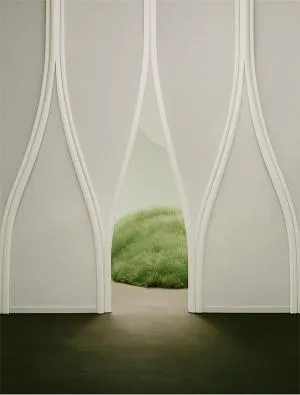
Liubou Vaitovich / Beyond Static Space: A Modular Framework for Adaptive Domestic Environments
Although most homes still appear visually the same as they did a half century ago, their relationship to humans and their surrounding environment has changed significantly in recent years.
Conventional residential design is often constrained by rigid layouts, poor adaptability to evolving lifestyles, and insufficient opportunities for individual personalization. As a result, spatial arrangements tend to become outdated rapidly.
This project presents a new perspective on architectural flexibility. Grounded in an analysis of daily human activities and their spatial dynamics, the concept introduces a modular system composed of autonomous elements. These components can be rearranged into diverse configurations, enabling a variety of spatial experiences that reflect the changing needs of residents.
By incorporating mobile robotic units equipped with sensors and computer vision, the system allows for real-time spatial adaptation. This technological integration makes it possible to generate an almost limitless range of configurations, offering a high degree of personalization. The system also addresses environmental comfort: interchangeable panels regulate acoustics, temperature, and natural light, while integrated LED lighting provides adjustable illumination during darker hours.
The system is made up of multifunctional components designed for disassembly, reuse, or recycling. This approach supports zero-waste manufacturing and significantly reduces construction debris and material waste.
To explore the architectural implications of the system, it was applied within the framework of Greenbelt Case Study No. 4 by Ralph Rapson — a residence originally conceived to accommodate diverse and changing user needs. In this context, the project expands the notion of reconfigurable domestic architecture and suggests new ways of designing homes that evolve in step with the lives they contain.

Sandra Natalia Trochimowicz / Computational Methods for Wood Off-cuts in Architecture
The construction industry produces vast quantities of wood waste, much of which remains under-utilised despite wood being a renewable and versatile material. This study introduces a computational framework to repurpose wood offcuts into modular, load-bearing components for small-scale architectural applications.
The aim is to transform discarded wood into valuable building elements by leveraging computational design, parametric modelling, and sustainable assembly techniques. This approach not only reduces construction waste but also demonstrates the potential of wood as a critical material for circular-economy-driven architecture.
This diploma project tackles the awkward pile of odd-sized spruce and pine that Swedish crews sweep up at day’s end. Instead of grinding those scraps into biofuel, I build a computational workflow that digitally models these offcuts, sorts them, fits them, and finally turns them into dowel-laminated, load-bearing modules connected with structurally optimised bracing in the form of a space-frame system.
To demonstrate practical application, the method is applied in the design of a state-of-the-art pavilion proposed for the “Slow Down” Copenhagen Architecture Biennial 2025 competition, to highlight the system’s functionality and adaptability. The Slow WOODs Pavilion rethinks how we build—and how we pause. It celebrates material by-product rather than virgin supply. In place of walls, a translucent cotton veil filters Copenhagen’s light; in place of benches, a gently planted micro-forest invites moments of rest. The pavilion’s plan, referencing the Danish firelænget gård, frames an inward courtyard where people can assemble, read, and reconnect. Every dowelled joint is dry-fitted for rapid assembly and disassembly, embodying a zero-waste ethos. Through this experiment, I ask: can architecture slow time as well as structure? By elevating waste wood to both structural and social purpose, the Slow WOODs Pavilion becomes simultaneously a place for pause and proof of circular possibility.
The research conducted in this thesis integrates theoretical and practical approaches. Computational processes such as parametric modeling, algorithmic assembly, and structural optimisation form the backbone of this document. Additionally, experimental methodologies, including physical prototyping and structural testing, ensure that the developed systems are both viable and effective. By combining these elements, the work aims to contribute not only to architectural innovation but also to the broader discourse on sustainability and material efficiency in an era of resource scarcity.
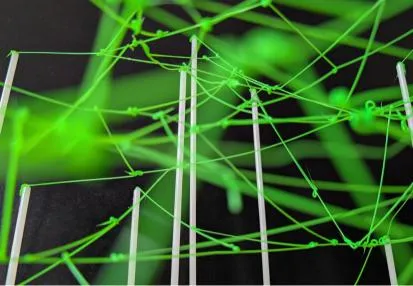
Sina Jaberi / Non-Planar 3D Printing: Inspired by the Efficiency of Spider Webs
This project investigates non-planar 3D printing techniques using a robotic system and PLA filament, drawing inspiration from the spider web’s structure.
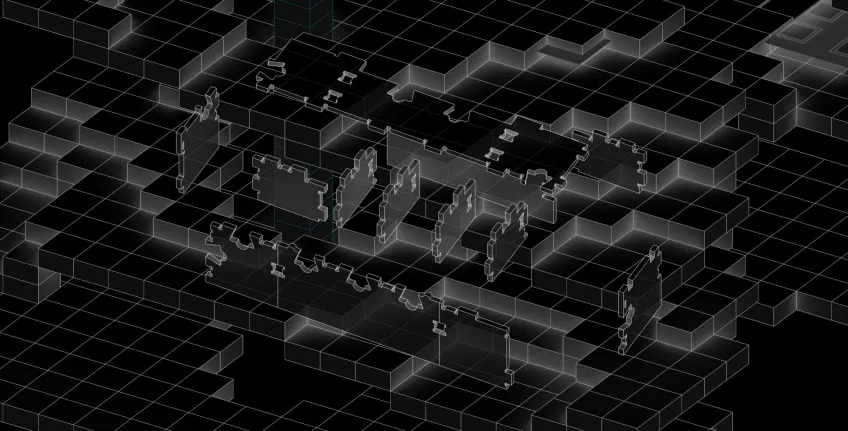
Zhengyang Zhang / WikiHouse
This thesis reverse-engineers the WikiHouse open-source construction system, breaking it down into fine-grained scales to explore new possibilities for formal complexity. Through a dialectical process—first a negation (analytical decomposition), then a negation of the negation (systemic reintegration)—it develops a new set of construction components that remain compatible with the original logic but allow for greater spatial freedom.
Rather than discarding the system, this work critically reappropriates it. The initial step involves dissecting the standard components, identifying their structural and formal constraints. The second step synthesizes new elements that expand the system’s expressive capacity without abandoning its principles of accessibility, modularity, and digital fabrication.
The aim is not aesthetic freedom for its own sake, but to test whether increased formal complexity can emerge from the same production logic—and whether such complexity can still support collective, democratized modes of construction. The project challenges the boundaries between standardization and creativity, questioning whether technical systems can be restructured to serve broader social and architectural goals.