
Collaborative Housing in a Pandemic Era (CO-HOPE)
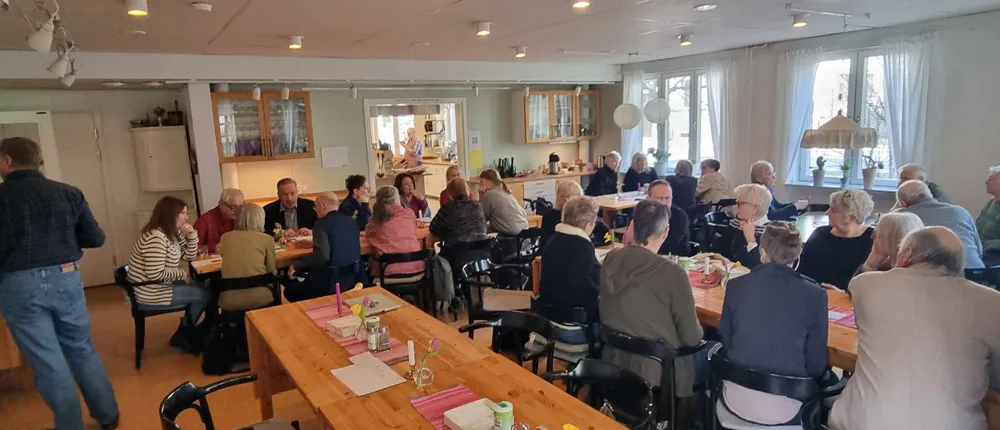
CO-HOPE was an inter- and transdisciplinary research project carried out from April 2022 to March 2025. The CO-HOPE consortium consisted of researchers and practitioners in the fields of collaborative housing, architecture, urban planning, geography, social work and health; and country teams were based in Sweden, Austria, France and Spain.
Main applicant
Lund University, Sweden
- Ivette Arroyo
Principal Investigator from 1 January 2024 - Anders Lund Hansen
Principal Investigator from 1 April 2022 to 31 December 2023
Co-applicants
- Robert Temel (Austria)
CO-HOPE (Robert Temel's website) - Christian Peer, Technische Universität Wien (Austria)
CO-HOPE (Technische Universität Wien's website) - Michel Lussault, University of Lyon (France)
CO-HOPE (University of Lyon's website) - Pierre Arnold, urbaMonde-France (France)
CO-HOPE (urbaMonde-France's website) - Esteban de Manuel Jerez, Universidad de Sevilla (Spain)
CO-HOPE Universidad de Sevilla's website)
Cooperation partners
- The Municipality of Lund
- Kollektivhus Nu
- Ferrum arkitekter AB
- Arkitektgården AB
- Sensus Studieförbund Region Skåne-Blekinge
- Initiative Gemeinsam Bauen & Wohnen
- Tampere University, Outi Jolanki
- Habitat Participatif France
- Hal’âge
- L’Epok
- LiSA (Vienna)
- EMVISESA
- Taller Ecosocial Habitat4
Aim and purpose
CO-HOPE addressed the health, housing, and social crises triggered by the COVID-19 pandemic. The project examined the resilience of residents in Collaborative Housing (CH) communities across Sweden, Austria, France, Spain, and Finland. It also co-created a participatory process for future CH development, produced recommendations for policymakers, and built capacity through higher and popular education. A key focus was understanding the benefits of living and ageing together in CH communities across consortium countries.
Definition of collaborative housing
Collaborative Housing (CH) provides an alternative way of living, where residents live in complete apartments or housing units while sharing additional common spaces that foster social interaction and balance between privacy with community life. CH is characterized by residents’ active participation in planning, design, construction, and management, as well as self-governance through democratic processes. CO-HOPE broadens this definition by providing empirical evidence that collaborative housing is a resilient way of living, supporting self-organisation of collective activities and enhancing social connection, while enabling sharing practices, mutual support and caring practices in everyday life.
Interdisciplinary research component
CO-HOPE focused on creating knowledge on the nexus between housing affordability, social integration and health through examining collaborative housing communities located in Sweden, Austria, France, Spain and Finland. The interdisciplinary research was carried out through a mixed-methods design. An online quantitative survey was responded by 393 residents living in 49 different collaborative housing communities located in Sweden (167 respondents, 27 CH), Austria (65 respondents, 4 CH), France (102 respondents, 14 CH), Spain (43 respondents, 3 CH) and Finland (16 respondents, 1 CH).
Qualitative empirical data was collected through onsite observations, interviews and focus group discussions with residents from 14 case studies in five European countries (See Figure 1).
Case study findings – summary
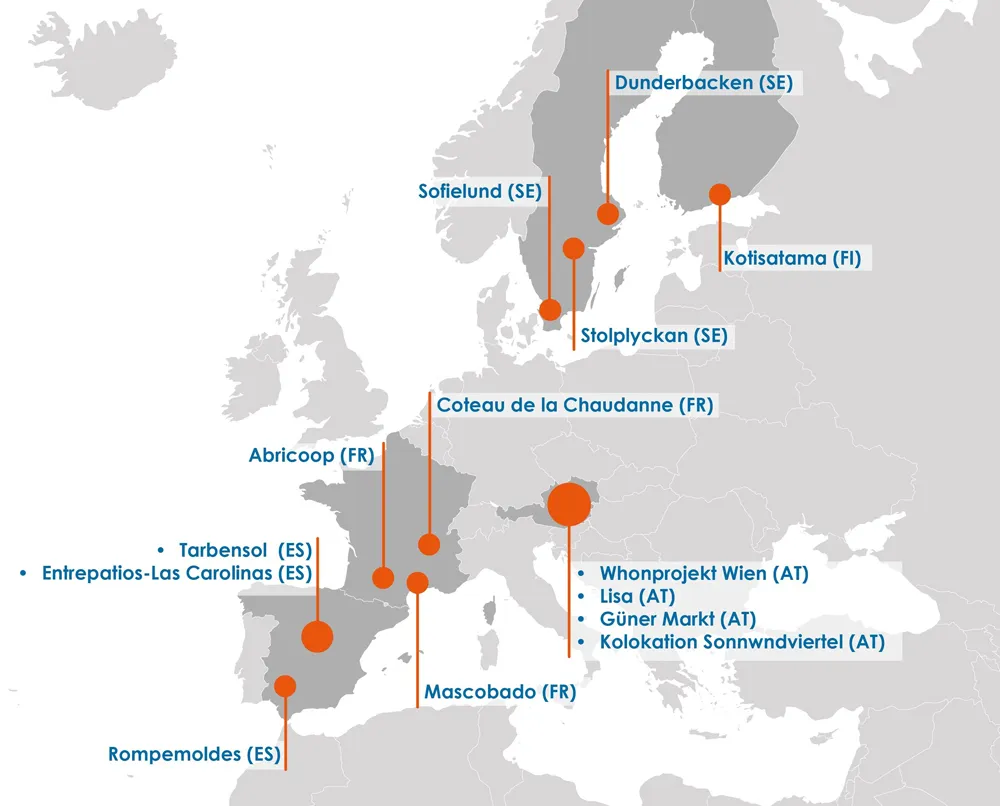
Sweden
- Stolplyckan (Linköping)
- Dunderbacken (Stockholm)
- Sofielund (Malmö)
Austria
- Wohnprojekt Wien (Vienna)
- Grüner Markt (Vienna)
- Kolokation Sonnwendviertel (Vienna)
- LiSA (Vienna)
Finland
- Kotisatama (Helsinki)
France
- Abricoop (Toulouse)
- Coteau de la Chaudanne (Grézieu la Varenne)
- Mascobado (Montpellier)
Spain
- Las Carolinas (Madrid)
- Rompemoldes (Sevilla)
- TrabenSOL (Torremochade Jarama)
Key research insights
Growing trend with shared challenges
Collaborative housing is trending in all participating countries. Common challenges include both lack of affordable land for developing new collaborative housing projects and shortage of affordable buildings available for conversion into collaborative housing. There is also lack of knowledge of collaborative housing among public servants, the public, architects, banks, and developers; and therefore, insufficient support from the public sector.
Resilience during crises
Residents of the 14 case studies created new routines during the COVID-19 pandemic through self-organisation and due to the availability of common spaces, showing that collaborative housing fosters strong crisis preparedness.
Key success factors
Collaborative Housing communities vary in size, design, tenure, and context. CO-HOPE found four factors that are essential for successful collaborative housing arrangements, which are demographic structure, self-organisation, physical structure and sharing practices.
Enabling living and ageing together
Collaborative housing enables the kind of ageing in place where older adults are stimulated and given purpose by significant social interaction, reducing the risk of feeling lonely or being isolated in everyday life.
Family-friendly environments
Voluntary childcare and safe communal spaces foster intergenerational support and children’s wellbeing.
Building stronger neighbourhoods
Opening communal spaces to the public and engaging in local initiatives strengthens social ties within and beyond the collaborative housing community.
Transdisciplinary co-creation
The CO-HOPE Urban Living Lab brought together consortium members, residents, civil society, practitioners, and policymakers through a series of online exchanges, study visits to collaborative housing communities, and workshops in Sweden, Austria, France and Spain. Key events included a co-creation workshop in Seville (Nov 2022), an expert meeting between academics and CH residents in Stockholm (Sep 2023), an international workshop and conference in Vienna (Dec 2023); as well as a policy workshop and conference in Lyon (June 2024). These activities led to two main co-created outputs: a guidebook and a policy brief.
- The Guidebook “Co-Creating Collaborative Housing Communities” coordinated and edited by Robert Temel (TU Wien's website)
- The Policy Brief “Collaborative Housing in Europe. Living laboratories of the future”, coordinated and edited by urbaMonde-France (PDF, urbaMonde's website)
Capacity Building
The key lessons of CO-HOPE were shared with wider audiences through higher and popular education. Activities included a 40-hour online course for 50 participants from multiple countries, a practitioner webinar, and a public study circle at CH Rompemoldes in Spain. The University of Seville, through ETSIE, ETSA, and the ADiCi group, coordinated these efforts.
- Higher education course “Collaborative Housing: Living Laboratories of the Future” (sites.google.com)
- Webinar “ContextualisingCollaborative Housing from an International Perspective” (sites.google.com)
Funding
CO-HOPE received funding from JPI Urban Europe and the Joint Call for Proposals for research and innovation projects on Urban Transformation Capacities (Urban Europe's website), Co-funded by the European Commission (Grant N° 101003758). CO-HOPE was carried out from 1 April 2022 to 31 March 2025. The Swedish team within CO-HOPE received funding from the Swedish Energy Agency (Energimyndigheten).
The Swedish team
(Links open i Lund University's Research portal)
Researchers from Lund University included Ivette Arroyo, Norma Montesino and Marianne Granbom, who studied Stolplyckan, Dunderbacken and Sofielund (Sweden). Laura Liuke conducted fieldwork in Kotisatama (Finland) and access was facilitated by Outi Jolanki (Tampere University's Research portal).
- Intergenerational caring in collaborative housing: older adults and mutual care in France
- Aksümer, Gizem, Lussault, Michel
- 2025
- Book: Collaborative Housing, Ageing and Social Care: Lessons from Europe, Bristol University Press. Fernández Arrigoitia, M., Felstead, A., Hudson, J., Izuhara, M. Scanlon, K. and West, K. (eds.)
- L’Habitat Participatif en Europe. Un laboratoire habité du futur.
- Arnold, P., Brandt, M., Cauletin, M., Bourgeaiseau, P., Lussault, M.
- 2025
- Book: Recommandations de politique publique. Paris: urbaMonde.
- Living and ageing together in Collaborative Housing. Older adults’ social possibilities, health and wellbeing across four European countries.
- Arroyo, I., Aksümer, G., Hastings, C., Liuke, L., Montesino, N., Granbom, M., Höpler, R., and Peer, Ch.
- 2025
- Housing Studies
- Agency and self-organised care experiences in Sweden’s Collaborative Housing for the Second Half of Life
- Arroyo, I., Montesino, N. and Granbom, M.
- 2025
- Book: Collaborative Housing, Ageing and Social Care: Lessons from Europe, Bristol University Press. Fernández Arrigoitia, M., Felstead, A., Hudson, J., Izuhara, M. Scanlon, K. and West, K. (eds.)
- Co-Creating Collaborative Housing Communities : A Guidebook (TU Wien's website)
- Temel, R., Peer, C., Höpler, R., Leutgöb, J., Arroyo, I., Kärnekull, K., Egerö, U., Westholm, H., Hansson, C., Arnold, P., Brandt, M., Cauletin, M., Melo, A., de Manuel, E., & Arriero, C.
- 2025
- Collaborative Housing in Europe. Living laboratories of the future.
- CO-HOPE
- 2025b
- Policy Brief. Paris: urbaMonde.
- Bogemenskaper i Europa – Levande laboratorier för framtiden. Rekommendationer till beslutsfattare i Sverige.
- Egerö, U., Kärnekull, K., Arroyo, I., Westholm, H., and Granbom, M.
- 2025
- Policy Brief. Lund: Lund University.


Principal Investigator
Ivette Arroyo
- Housing Development & Management
- Department of Architecture and Built Environment
- Lund University (Sweden)
Ivette Arroyo's profile in Lund University's Research Portal

Researcher
Norma Montesino
- School of Social Work
- Departments of Administrative, Economic and Social Sciences
- Lund University (Sweden)
Norma Montesino's profile in Lund University's Research Portal

Researcher
Marianne Granbom
- Active and Healthy Ageing Research Group
- Department of Health Sciences
- Lund University (Sweden)
Marianne Granbom's profile in Lund University's Research Portal